US Open Day 11 Preview — Wednesday, September 9, 2026: Gauff enters the 5–0 trap, Rybakina plays for No. 1, and Blockx plays through pain
Coco Gauff has never lost to Mirra Andreeva. Elena Rybakina is one win from the top of the rankings. Alexander Blockx is one damaged ribcage from the greatest day of his career. Wednesday brings four quarter-finals whose cleanest numbers conceal the messiest questions.
New York finally went to bed at 3.30am, shortly after Ben Shelton sent a 146mph serve bending away from Carlos Alcaraz and into US Open history.
Day 11 begins at 11.30am.
Eight hours is barely a recovery window. Flushing Meadows has filed it as a changeover.
Wednesday’s programme contains none of Tuesday’s all-American guarantees, but it may have more unstable favourites. Coco Gauff brings a perfect 5–0 record against Mirra Andreeva into a match against a version of Andreeva she has never met: a major champion who says she has stopped treating every match as proof that the first title was real.
Elena Rybakina can become world No. 1 by beating Zheng Qinwen, which sounds straightforward until remembering that Zheng has spent consecutive matches falling 0–5 behind and winning anyway. Karen Khachanov meets 21-year-old Belgian breakthrough Alexander Blockx, whose first US Open quarter-final has arrived with a sharp pain in his ribs. Alexander Zverev closes the night against Botic van de Zandschulp, a man who required 409 points and five hours, 13 minutes to earn the appointment.
The records are clear. The people carrying them are rather more complicated.
Read Tuesday’s Day 10 debrief: Shelton’s 3.30am removal of the defending champion
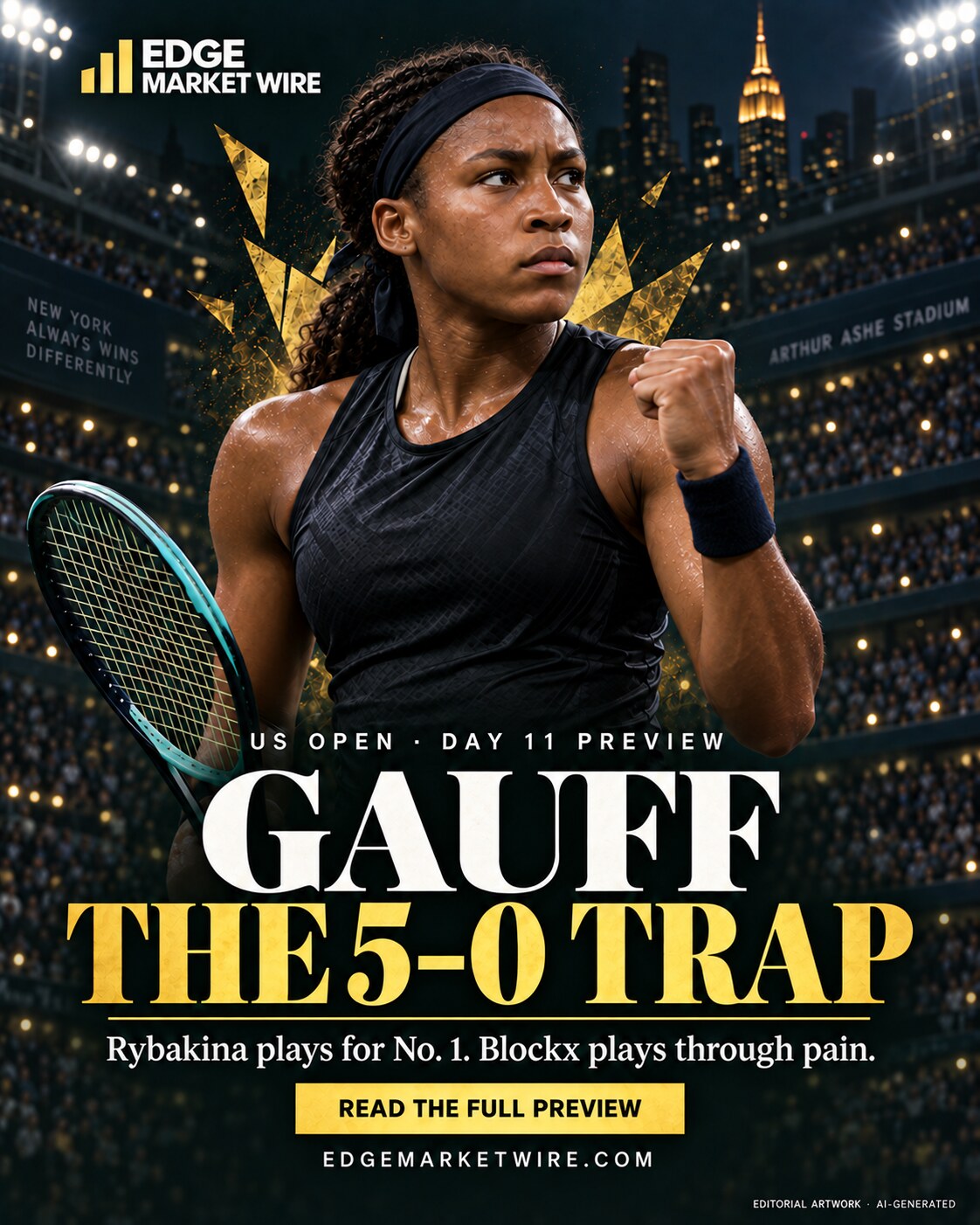
Gauff enters the 5–0 trap
Five meetings, five Gauff victories.
That is either an enormous psychological advantage or a beautifully upholstered trap.
Gauff has earned the record honestly. She beat Andreeva at Roland Garros and the US Open during the Russian’s breakthrough 2023 season, twice more on clay in 2025 and again in Rome this May. That latest meeting lasted three sets: Andreeva took the opener before Gauff gradually took away the centre of the court and won 4–6, 6–2, 6–4.
The fourth seed now arrives on a nine-match winning run, carrying the Cincinnati title and 20 consecutive sets. Her fourth-round dismissal of Iva Jovic, 6–1, 6–4 in 80 minutes, was the performance in which the various improvements finally appeared in the same picture. Gauff doubled Jovic’s winner count, 18 to nine, made half as many unforced errors, 15 to 30, and finished the match by serving and volleying on match point.
That last detail was not theatre. It was evidence of what Gauff believes has changed.
“I think that gives me confidence knowing that I have probably, up to this point, like, a plan D,” she said. “There’s comfortability in having options. If plan A doesn’t work, there’s B, there’s C and there’s D.”
The old version of this matchup could be reduced too easily to Andreeva trying to hit through the quickest defender in the draw. The new one contains more doors. Gauff is serving with greater conviction, taking the forehand earlier and using the net as part of the point rather than emergency accommodation.
Andreeva has noticed.
“I think she’s now also improving even more,” she said when asked about Gauff. “Her serve is better. I felt like she was trying to go into the net a little bit more, trying to be more aggressive.”
The fifth seed has changed too. She is 19, the reigning Roland Garros champion and in her first US Open quarter-final. Her 5–7, 6–4, 6–3 recovery against Anastasia Potapova was her first dropped set of the tournament, and it exposed both the risk and the upgrade. Andreeva can still become impatient when the first attacking pattern fails, but she no longer treats the failure as a verdict.
After winning in Paris, she went 4–4 across her next four events and began to feel that every match had become an obligation. Her adjustment has been wonderfully blunt: pretend the French Open was just another tournament.
“Maybe I’m more at peace in a way that I’m not as demanding of myself anymore,” Andreeva said. “Now I just approach it, OK, I won not a Grand Slam, I won just another tournament … trying not to think about it, chill, enjoy.”
That is the player Gauff means when she says the previous matches “could have almost gone either way”, but Andreeva is now “in a different mindset”. The head-to-head still matters. So does the fact that its owner refuses to hide behind it.
“I think it’s going to be a really athletic, tough match,” Gauff said. “Hopefully I can take my opportunities when I get them.”
The tactical question is not whether Andreeva can produce enough variety. Andy Roddick believes she may be “one of the only people that can match the variety of Coco”. It is whether she can vary the point without offering Gauff the extra ball from which defence becomes attack.
Roddick’s description of Gauff’s win over Jovic was exact: “She is shrinking the court to where you’re only hitting a winner if you’re bringing the ball within inches of the line.”
Andreeva must accept that some excellent attacks will come back, then play the next ball without treating the baseline as suddenly narrower. Gauff must do the opposite psychological job: respect the new major champion without allowing five previous victories to become a reason for caution.
The 5–0 record is real. It does not play the first point.
The Guardian’s courtside report on Gauff’s win, her “plan D” and the 5–0 history
Official US Open review of Andreeva’s new post-Roland Garros mindset
Served with Andy Roddick: Gauff’s shrinking court and Andreeva’s matching variety
Rybakina is one win from No. 1 — Zheng has stopped respecting the scoreboard
Elena Rybakina defeated Naomi Osaka 6–1, 6–4 with 29 winners, seven aces and only 17 unforced errors. She has lost 25 games in four rounds, reached her first US Open quarter-final and completed the set of quarter-final appearances at all four majors.
One more victory takes her to world No. 1 after the tournament.
“Of course, I want it. I don’t know anyone who wouldn’t wish this,” Rybakina said. “But definitely that’s one of my goals. I try to approach the same way. Try to do everything I can. Fight until the end [of] my next match, and let’s see what’s gonna happen.”
The danger sits inside that last match.
Zheng missed last year’s US Open while recovering from right-elbow surgery and had to qualify for this one. She has now reached the quarter-finals in each of her past three appearances in New York, carrying a seven-match winning run and the strangest recurring plot of the fortnight.
Against Madison Keys, Zheng trailed 0–5 in the deciding set and won. Against Iga Swiatek, she trailed 0–5 in the opening set and won it 7–5 before taking the second 6–3.
“I guess to come back from 0–5 is not lucky,” she told the Ashe crowd. “That’s all I can say.”
It is a persuasive argument. It is not a recommended starting position against Rybakina.
The second seed’s serve and first forehand remove recovery time rather than merely games. Osaka learned that quickly. Rybakina caught several lines, but the result was not built on fortunate paint: she established the first strike, kept the error count low and never allowed Osaka’s own aggression to acquire rhythm.
Zheng’s route is to make Rybakina defend after the serve. Her forehand can take the first neutral ball away early, and her return position must prevent the Kazakh from treating service games as administrative work. The comeback habit demonstrates nerve; the opening deficit still reveals how long Zheng has sometimes needed to locate her range.
Rybakina leads their series 4–1. Both meetings this year — on Doha hard courts and Madrid clay — required three sets. That matters more than the raw total. Zheng already knows she can extend the contest into the uncomfortable part of Rybakina’s game; Rybakina knows the current ranking beside Zheng’s name describes an absence, not a level.
“She definitely found her form,” Rybakina said, “and I feel like she’s playing now with a lot of confidence after so many wins in a row, so she’s very dangerous.”
The ranking prize gives Rybakina the cleaner headline. Zheng’s fortnight supplies the better warning label.
The WTA on Rybakina’s Osaka rout, the No. 1 equation and her Zheng assessment
Official US Open results and Zheng’s second recovery from 0–5
Official US Open quarter-final preview: Rybakina vs Zheng
Blockx has made history; now the ribs set the terms
Alexander Blockx’s first match on Arthur Ashe began with a sharp pain in his ribs during the second game. It ended with him flat on the court, the first Belgian man ever to reach a US Open singles quarter-final.
The distance between those two moments was 43 games.
Blockx beat Francisco Cerundolo 6–3, 4–6, 7–5, 7–5 despite requiring treatment and medication. Only four points separated the players. Cerundolo created 17 break points and converted three; Blockx saved the other 14, then broke in the final game of both the third and fourth sets.
“If I would have lost the third set, I think the chances were really high of me retiring,” Blockx said.
There is no confirmed withdrawal and he remains on Wednesday’s schedule. There is also no useful way to pretend the physical question has vanished. Blockx said later that even with “a lot of medication” in his body, he could still feel the pain.
Khachanov is an unforgiving opponent for a damaged torso. The Russian has reached six previous major quarter-finals, including the 2022 US Open semi-finals, and arrived at this one by outlasting Learner Tien 7–5, 4–6, 6–7(6), 6–1, 6–4. His heavy serve and repeatable cross-court weight ask an opponent to rotate, defend and strike one more ball for several hours.
Khachanov understood that demand before facing Tien. Roddick later highlighted his post-match explanation: “I knew I was going to have to play that extra ball every point. I knew that Learner was going to take me to a place where I had to play that extra ball compared to somebody else.”
Now Khachanov becomes the person administering the extra ball.
Blockx’s best chance is to keep the match from becoming a test of accumulated movement. His serve survived remarkable pressure against Cerundolo, and the forehand is big enough to shorten neutral exchanges. But pain around the ribs can interfere with the service rotation, the open-stance forehand and the small acts of recovery between points. The match may reveal its central fact before either player settles tactically.
The Belgian’s response to his breakthrough has been pleasingly free of mythology.
“I just do my thing. I work hard,” he said. “Even though I have tough losses sometimes I know that good times are always coming. And now it’s one of those good times.”
The good time is scheduled for 2pm. The body has not yet confirmed the booking.
Official US Open report on Blockx’s breakthrough, rib pain and break-point escape
Tennis365’s extended Blockx interview on the injury and medication
Served’s Day 9 notes on Khachanov’s “extra ball” mindset
Zverev rented the night shift; van de Zandschulp survived the overtime
Alexander Zverev has played every match of this US Open on Arthur Ashe at night. After finally finishing one before midnight, he pointed at his watch and appeared briefly unsure how normal people use the remaining hours.
“I might go back to the practice court, I might go out to a bar, I don’t know yet,” he said after beating Luciano Darderi 6–2, 6–2, 7–6(3). “Unfortunately, that was a joke, so relax.”
Zverev’s earlier line was better. Ashe is not his court, he insisted; Roger Federer and Pete Sampras have won there too often for that. “But I feel like I rented this court out, like from 11pm to 2am for two weeks.”
The lease has been renewed, though Wednesday’s night session begins at the almost civilised hour of 7.30pm.
The top seed needed five sets in each of his first two rounds and spent nine hours, 26 minutes on court before the third. Since then the tennis has tightened. He beat Alejandro Tabilo and Darderi in straight sets, leads the tournament with 64 aces and is the only man to have reached the quarter-finals at all four majors this season. The reigning Roland Garros champion has moved from survival to control without losing the benefit of the survival.
Van de Zandschulp has taken the opposite route.
The Dutchman lost the first two sets to lucky loser Arthur Gea, saved a match point and recovered 3–6, 6–7(0), 7–6(7), 7–6(3), 6–4. The match lasted five hours, 13 minutes and contained a US Open-record 409 points. Gea won more of them. Van de Zandschulp won the one that ended the match.
It returned him to the quarter-finals here for the first time since his qualifier run in 2021.
“I think this is probably better than the first quarter-final I made here,” he said. “It hasn’t sunk in yet, but I think tomorrow, it’s going to be a great feeling.”
This is the first professional meeting between Zverev and van de Zandschulp. The matchup favours the German’s serve, depth and fresher legs, but the Dutchman has a useful New York history of refusing the obvious hierarchy. His straight-sets removal of Alcaraz at the 2024 US Open remains one of the tournament’s great recent ambushes.
To repeat the trick, he must take time away from Zverev’s forehand without donating errors to the backhand. Zverev’s vulnerable phase this fortnight came when his court position drifted and the first serve stopped ending points. Van de Zandschulp has the flat ball to expose that position. Whether he has the legs to keep exposing it after 409 points is the less romantic question.
Zverev has rented the night. Van de Zandschulp arrives carrying the invoice for overtime.
Official US Open report on Zverev’s improving level, 64 aces and late-night jokes
Roland-Garros on van de Zandschulp’s 5h13 recovery and return to the last eight
ATP head-to-head: a first meeting for Zverev and van de Zandschulp
Wednesday’s order of play
**17:30 CEST / 11:30am ET** — Zheng Qinwen vs Elena Rybakina, Arthur Ashe Stadium.
**Not before 18:30 CEST / 12:30pm ET** — Mirra Andreeva vs Coco Gauff, Arthur Ashe Stadium.
**Not before 20:00 CEST / 2:00pm ET** — Karen Khachanov vs Alexander Blockx, Arthur Ashe Stadium.
**01:30 CEST Thursday / 7:30pm ET** — Alexander Zverev vs Botic van de Zandschulp, Arthur Ashe Stadium.
The first three matches form one continuous day session, so the “not before” times are floors rather than appointments. A long opener will move everything behind it. The National Weather Service expects a mostly sunny high near 29C, followed by a partly cloudy night around 23C. South-westerly gusts may be the more relevant variable than rain.
Official US Open Day 11 order of play
National Weather Service forecast for Flushing
The closing read
Rybakina begins the day with the largest immediate prize. Win once and the No. 1 ranking is hers. Zheng begins with the more dangerous freedom: she has already lost the same match twice this week and escaped both versions.
Gauff owns the strongest head-to-head, the home crowd and the cleaner recent tennis. Andreeva owns the change the record cannot show. She has won a major, lived through the burden of it and arrived in New York determined to make the title feel ordinary enough to enjoy.
Khachanov should be able to turn Blockx’s afternoon into a physical examination. The uncertainty is whether the Belgian’s ribs allow him to sit it. Zverev should control the night, but van de Zandschulp has already spent five hours proving that a match can award the majority of its points to one man and its future to the other.
Tuesday was the night of the kingslayer. Wednesday belongs to four cleaner favourites and four reasons not to become comfortable.
The first point arrives at 11.30am.
New York has had nearly eight hours of sleep. That will have to do.
Expected tennis start times can move when earlier matches run long or weather intervenes. Market context, not a guarantee of profit.