US Open Day 10 Debrief: Kingslayer! Shelton ends Alcaraz’s reign after 3am
Ben Shelton served 146mph on match point to remove the defending champion, Frances Tiafoe borrowed another life, Aryna Sabalenka escaped the Wimbledon champion and Jessica Pegula won an argument with herself. Tuesday began as a quarter-final programme and ended as a New York fever dream.
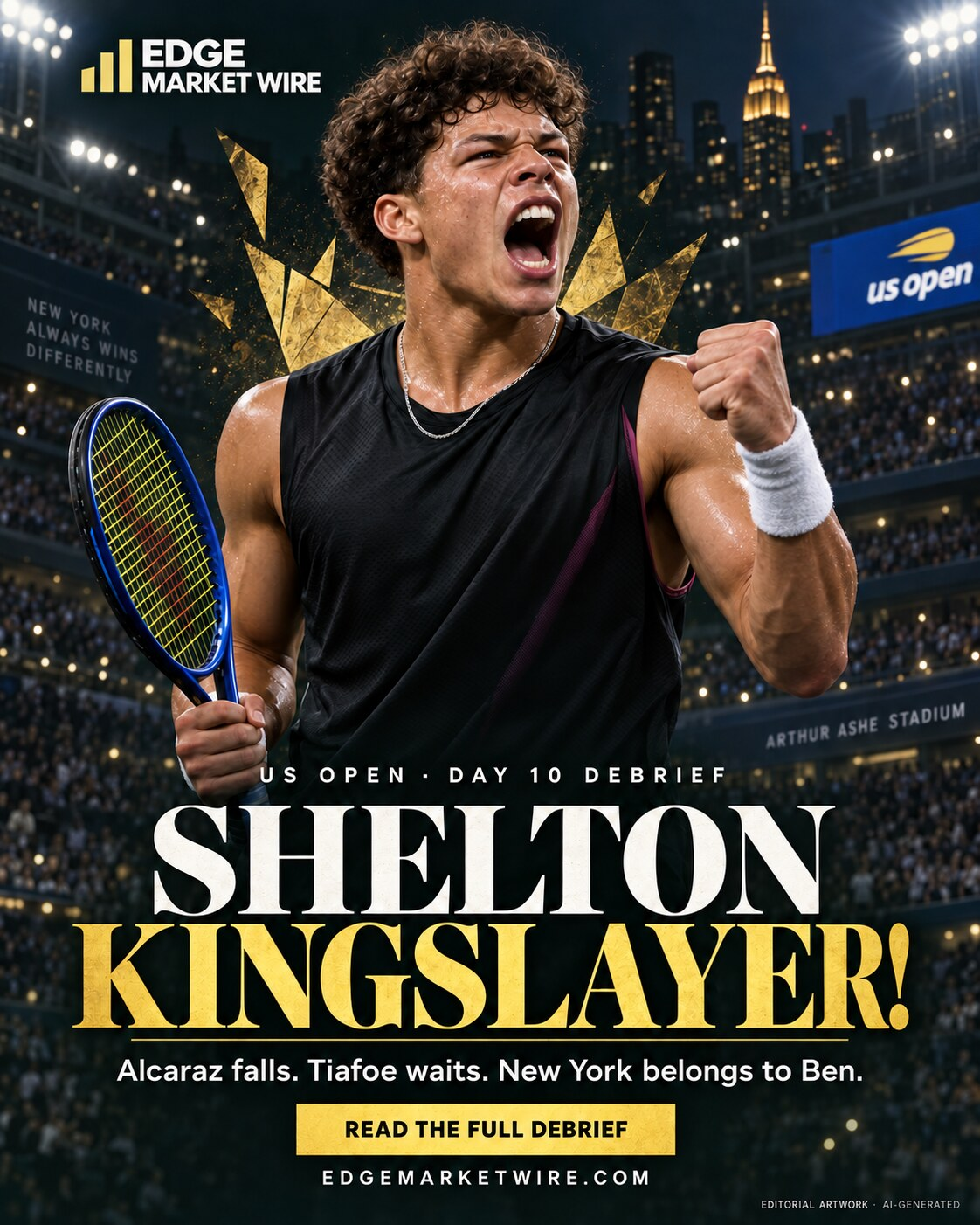
The king is dead. Long live the king.
The second sentence may be slightly premature. Ben Shelton still has to win two more matches before anyone hands him the US Open trophy. After 3.30am inside Arthur Ashe Stadium, however, restraint felt like a peculiar demand.
Carlos Alcaraz — defending champion, two-time winner in New York and the youngest man to complete the career Grand Slam — had just been removed from his throne by a 146mph serve out wide. Shelton had never beaten him. He had never beaten a top-five player at a major. Alcaraz had never lost to an American at a Grand Slam.
Then Shelton beat him 6–7(5), 6–1, 6–3, 1–6, 7–6(7), in the latest finish in US Open history.
No crown was awarded. One was very clearly knocked sideways.
Tuesday promised fireworks. It delivered them eventually, after several hours of rescue work. Frances Tiafoe came back from two sets and a break down, then from two points away from defeat. Aryna Sabalenka recovered from 4–2 down in the deciding set. Jessica Pegula lost the opening set, fell behind again in the third and spent much of the evening fighting both Emma Navarro and her own serve.
Then Shelton turned up with the heavy machinery.
Kingslayer
Shelton had promised fireworks before the match. For most players, that is promotional copy. For Shelton, it was a tactical plan.
The serve reached 149mph in the opening set. He repeatedly followed it forward, won eight of his first nine net points and took six of seven serve-and-volley points. He dragged Alcaraz into a 12-shot scramble, chased down a lob, improvised a tweener and made Arthur Ashe sound fully awake despite the clock moving towards midnight.
He also lost the set.
Alcaraz broke at love for 6–5. Shelton broke straight back and led 5–4 in the tiebreak, two points from taking the opener. Alcaraz then won the final three points. On set point, Shelton’s tweener kept an absurd rally alive before his forehand finally found the net.
There was an obvious way for the match to proceed from there. The champion had survived the spectacle, taken the score and reminded the challenger that highlights are not legal tender.
Shelton declined the lesson.
He saved three break points in a 16-point hold early in the second set, then broke Alcaraz in the next game. The return position became more aggressive. The first strike after the return became less decorative and more damaging. Alcaraz’s first-serve percentage fell from 65 per cent in the opening set to 50 in the second, his forehand began to leak and Shelton kept asking the next question before the Spaniard had completed his answer.
By the end of the set, Shelton had won 70 per cent of his second-serve points; Alcaraz only 44 per cent. The champion had made 32 unforced errors to Shelton’s 13. A double fault completed the 6–1 set.
This was the moment the match stopped being a large serve attached to an upset bid. Shelton was winning after the serve, too.
The third set supplied the proof. An early break put Shelton ahead, but the important sequence came when he served for it at 5–3. Alcaraz produced a break point and appeared ready to turn the rally into the sort of physical examination that normally exposes Shelton’s impatience. Instead, Shelton stayed in a 19-shot exchange and won it. He then outlasted Alcaraz across 11 shots for set point and forced one more error to take the set 6–3.
The left-hander had not merely shortened the match. He had beaten Alcaraz inside the long points Alcaraz is supposed to own.
Naturally, Alcaraz responded in the most Alcaraz fashion available. He appeared physically unwell and was sick into a towel, then made the fourth set look brief and uncomplicated. He broke early, broke again and took it 6–1. After more than four hours, Shelton’s middle-set surge had been reduced to a deciding set against the best emergency tennis player of his generation.
The fifth contained no break of serve and several small acts of refusal. Shelton saved a break point at 2–3 by coming forward. At 4–4, he reached 15–40 on the Alcaraz serve and eventually created three break points. One backhand missed. Alcaraz conjured a forehand volley to erase another. Shelton put a running backhand into the net on the third.
That was the danger: not simply that the opportunity had gone, but that Alcaraz had survived it. He has built a career from the psychological interest charged on chances opponents fail to convert.
Shelton held anyway. Then held again. Alcaraz forced the first-to-ten match tiebreak and the stadium passed the previous 2.50am record for the tournament’s latest finish. The subway could be heard. So could the garbage trucks. The crowd remained.
Shelton led 2–1 in the breaker, lost the minibreak and fell behind 5–3. A body serve brought him back within one. At 6–6, the players changed ends with the match reduced to four points of nerve and violence.
At 6–6, Shelton struck a 146mph serve that Alcaraz could not control. Alcaraz then missed a forehand to concede the minibreak, before rescuing the next point with a drop-volley winner. Shelton had two serves and an 8–7 lead.
Match point left his hand at 146mph and bent away from the court. Alcaraz reached but could not return it. Shelton roared. His father and coach, Bryan, rose in the box. Arthur Ashe produced the sort of noise that belongs less to an audience than to weather.
The final score was 6–7(5), 6–1, 6–3, 1–6, 7–6(7). The final-set breaker was 10–7. The match ended after 3.30am, four hours and 28 minutes after it began.
The numbers matter, but the method matters more. Shelton did not beat Alcaraz by closing his eyes and swinging harder. He varied the direction of the serve, used the body serve when Alcaraz began reading the corners, attacked the net and accepted long exchanges without treating them as personal insults. The 149mph serve created the threat. The discipline made the threat last for five sets.
Alcaraz had won their three previous meetings and seven of their eight sets. Shelton had taken only one set from him, on clay in Paris. On Tuesday night he took three, including the one played after the match had already offered him several respectable ways to lose.
This is Shelton’s second US Open semi-final and the largest victory of his major career. It also creates an all-American semi-final against Tiafoe, ensuring another American man will play for the title in New York two years after Taylor Fritz reached the 2024 final.
The title still has no new owner. The defending king, however, is gone.
ESPN’s completed scoreboard for Shelton’s five-set victory over Alcaraz
The Guardian’s courtside account of the match, the record-late finish and the deciding tiebreak
TNT Sports’ result report from the latest finish in US Open history
Tiafoe finds the exit after Michelsen closes the door
Alex Michelsen spent almost three sets making Frances Tiafoe look like the visitor.
That was a considerable achievement on Arthur Ashe, even with the arena oddly empty after Sabalenka and Noskova had exhausted much of the afternoon crowd. Tiafoe had won all ten of his previous matches on Louis Armstrong, his self-appointed people’s court. Ashe was supposed to offer a larger version of the same home advantage. Instead, Michelsen’s early contact and backhand kept the match quiet.
He took the first set 7–5, the second 6–3 and broke early in the third. At 5–3, he saved three break points, the last with a 134mph ace. He had not dropped a set all tournament. One more hold would have made him the first American man since Jim Courier in 1991 to reach the US Open semi-finals without losing one.
Then the finish entered the service motion.
Michelsen opened the game at 5–4 with consecutive double faults. Tiafoe broke, held and pressed again. A missed forehand volley at 5–6 handed him the set. The statistical hinge was small — two double faults and one volley — but the emotional transfer was complete. Tiafoe won 17 of the final 22 points in the set, and the returning crowd finally recognised the version of him it had come to see.
Michelsen broke back in the fourth and broke first in the fifth. Neither advantage lasted. Tiafoe, who had served only three aces across the first four sets, found seven in the decider. Three came inside the final four points of a difficult hold for 5–5.
The match reached a first-to-ten tiebreak after four hours and 38 minutes. At 8–6, Tiafoe struck a 135mph ace. At match point, he finished with a forehand pass. The score — 5–7, 3–6, 7–5, 6–3, 7–6(6) — records the recovery but not quite the distance between its two endings.
Michelsen had been four points from serving himself into a major semi-final. After the handshake he fell into Tiafoe’s arms and cried. Tiafoe held him there for 23 seconds, long enough for a tennis result to become a human one.
Tiafoe called it a “Braveheart-type win”. It is his third US Open semi-final in five years, making him only the second American man this century, after Andre Agassi, to reach three.
The more interesting line came when he looked forward. The player who made the last four in 2022 and 2024, he said, is not the player arriving there now. Friday will test the claim. Tuesday supplied the evidence.
The Guardian’s courtside account of Tiafoe’s five-set recovery and the embrace that followed
ESPN on the match and the emotion between Tiafoe and Michelsen
Sabalenka stops fighting herself
Aryna Sabalenka’s first two US Open titles were built on power. Her pursuit of the third in succession may depend on knowing when power is no longer the problem.
Linda Noskova made that distinction unavoidable.
Sabalenka won the first seven points and the first three games, then held two chances to lead 5–1. Noskova escaped, began landing the serve and broke when Sabalenka tried to close the set at 5–4. The champion took the tiebreak 7–1, but the match had already changed shape.
Noskova stopped treating pace as the only available language. Backhand passes, drop shots, net approaches and changes of height gave Sabalenka several decisions per rally. The Wimbledon champion took the second set 6–3 and then won ten consecutive points on serve while moving 4–2 ahead in the third.
At 2–2, Sabalenka had followed her second double fault with a crouch and a yell. It was the familiar warning sign from several difficult summer defeats: frustration beginning to occupy the space needed for problem-solving.
The useful change was almost invisible. From 2–4, the noise stopped. Sabalenka stayed in a longer exchange, reduced the unnecessary risk and waited for Noskova’s balance between finesse and force to slip. She broke back for 4–4.
Noskova still led 2–0 in the deciding tiebreak. Sabalenka answered by making the final points simpler. Four of her last five serves went unreturned, and match point disappeared with a second-serve ace out wide: 7–6(1), 3–6, 7–6(7) after two hours and 22 minutes.
Noskova produced 46 winners and 18 aces. Sabalenka did not overpower those numbers; she survived them. Afterwards she admitted that at 4–2 she had thought, “that was it”. Feeling the match leave her was what finally allowed her to play freely enough to retrieve it.
The victory extends her winning streak in New York to 18 matches and sends her into a sixth consecutive US Open semi-final. Two wins remain between Sabalenka and the first women’s three-peat here since Serena Williams in 2014.
The next opponent is Pegula. Familiarity will not make it gentler.
The WTA’s point-by-point account of Sabalenka’s recovery against Noskova
Official US Open report from the first quarter-final of the day
Pegula wins the argument with herself
Jessica Pegula’s quarter-final began more than an hour late because Tiafoe and Michelsen had declined to finish theirs. The air remained heavy. Her serve never became trustworthy.
Emma Navarro took the first set 6–3 by breaking twice and keeping Pegula in the uncomfortable position of generating pace without controlling the first strike. The rallies lengthened, the errors accumulated and neither player found much free movement through a service game.
Pegula’s improvement was not dramatic. It was stubborn. She took the second set 6–4, fell a break behind in the third and then returned to the patterns that have made her one of the tour’s best problem-solvers: early contact, protected court position and enough depth to make Navarro attack from slightly farther back than she wanted.
The deciding set moved 6–3 in Pegula’s direction. The match had lasted two hours and 21 minutes and felt physical for nearly all of them.
Pegula later described herself as “fighting a lot of demons”. That is useful context, not melodrama. She double-faulted, lost her preferred rhythm and still made the correction before the scoreboard ran out. Her best skill on Tuesday was a short memory.
This is her 50th victory of the season, the first WTA player to reach that number in 2026. It is also a third consecutive US Open semi-final and a fourth major semi-final overall. She is now 5–0 against Navarro, but three of those meetings have required a deciding set.
Sabalenka has beaten her in New York in each of the past two years, including the 2024 final. Pegula has just won a match without her best serve. Thursday asks whether she can do it against the best return pressure left in the draw.
The WTA on Pegula’s third-set recovery and return to the US Open semi-finals
Reuters’ match report, including Pegula’s 50th win of the season
The former-player read
Before Shelton walked on court, Andy Roddick reduced the upset route to one verb: disrupt.
On *Served*, Roddick argued that Shelton could not settle for safe second serves or chipped returns. He needed body serves, first serves that “buzz the tower” and enough aggression to prevent Alcaraz establishing the rhythm from which he normally solves everybody.
Greg Rusedski, speaking on *Off Court*, wanted more variation: kick, slice, flat and the occasional serve-and-volley. Brad Gilbert’s emphasis was the second-serve return. Take the risk early, he argued, because extended rallies would otherwise become Alcaraz territory.
The interesting part is that Shelton’s win borrowed from all three prescriptions without belonging entirely to any of them.
The raw disruption was obvious. A 149mph peak ensured Alcaraz never settled into a single return position. The body serve pulled the deciding tiebreak back towards level. The final serve was 146mph and curved out of reach.
But Shelton also used variation, followed the serve to the net and survived the long exchanges the experts had identified as dangerous. The 19-shot rally he won while serving for the third set may have mattered as much as any ace. It told both players that Alcaraz did not own every point once the ball came back.
On *Nothing Major*, Sam Querrey, John Isner and Steve Johnson had treated the late quarter-final as a test of whether Shelton’s improved return and movement could support the famous serve for long enough. The answer was five sets and a finish nearly three quarters of an hour beyond the tournament’s previous late-night record.
The same episode separated Michelsen’s “quiet surge” from the more visible Tiafoe story and questioned what moving that match to Ashe might change. Michelsen’s tennis travelled perfectly for almost three sets. What did not travel was the finish. The larger court mattered only when the larger moment arrived.
Roddick’s live ESPN diagnosis of Tiafoe was similarly precise. Tiafoe was changing the location and route of his second serve; the issue was not a lack of adjustment but execution under Michelsen’s constant pressure. The comeback should not be rewritten as a sudden tactical revelation. Tiafoe had been searching all afternoon. Michelsen’s two double faults finally gave the search room to work.
Tuesday’s lesson was not that expert previews are wrong. It was that the best ones identify a problem, not a destiny. Shelton still had to produce the answer after 3am.
Andy Roddick, Greg Rusedski and Brad Gilbert on the tactical route Shelton needed against Alcaraz
Nothing Major’s quarter-final discussion, including Shelton–Alcaraz from 23:36
Served’s Day 8 notes on Shelton, Tiafoe and the questions created by Alcaraz
Andy Roddick’s live ESPN diagnosis of Tiafoe’s serving adjustments
The draw now
Women’s semi-final created Tuesday
Aryna Sabalenka vs Jessica Pegula
Men’s semi-final created Tuesday
Frances Tiafoe vs Ben Shelton
Wednesday completes the other half. Elena Rybakina meets Zheng Qinwen, the qualifier who has recovered from 0–5 in consecutive matches. Coco Gauff takes a ten-match winning streak into Mirra Andreeva. Karen Khachanov faces Belgian breakthrough Alexander Blockx, before Alexander Zverev plays Botic van de Zandschulp.
Tuesday’s winners did not dominate their emergencies. They stayed available for the next point until the emergency changed sides.
Sabalenka thought the match was over. Pegula could not locate her serve. Tiafoe stood two points from elimination and later a break down in the fifth. Shelton lost the first set after leading its tiebreak, surrendered a two-sets-to-one advantage and missed three break points at 4–4 in the decider.
At 3–5 in the final breaker, the defending champion was five points from escape.
Shelton gave him no escape.
The king is dead. The next king is not crowned yet.
But he serves at 146mph, and New York has started rehearsing the ceremony.
Expected tennis start times can move when earlier matches run long or weather intervenes. Market context, not a guarantee of profit.