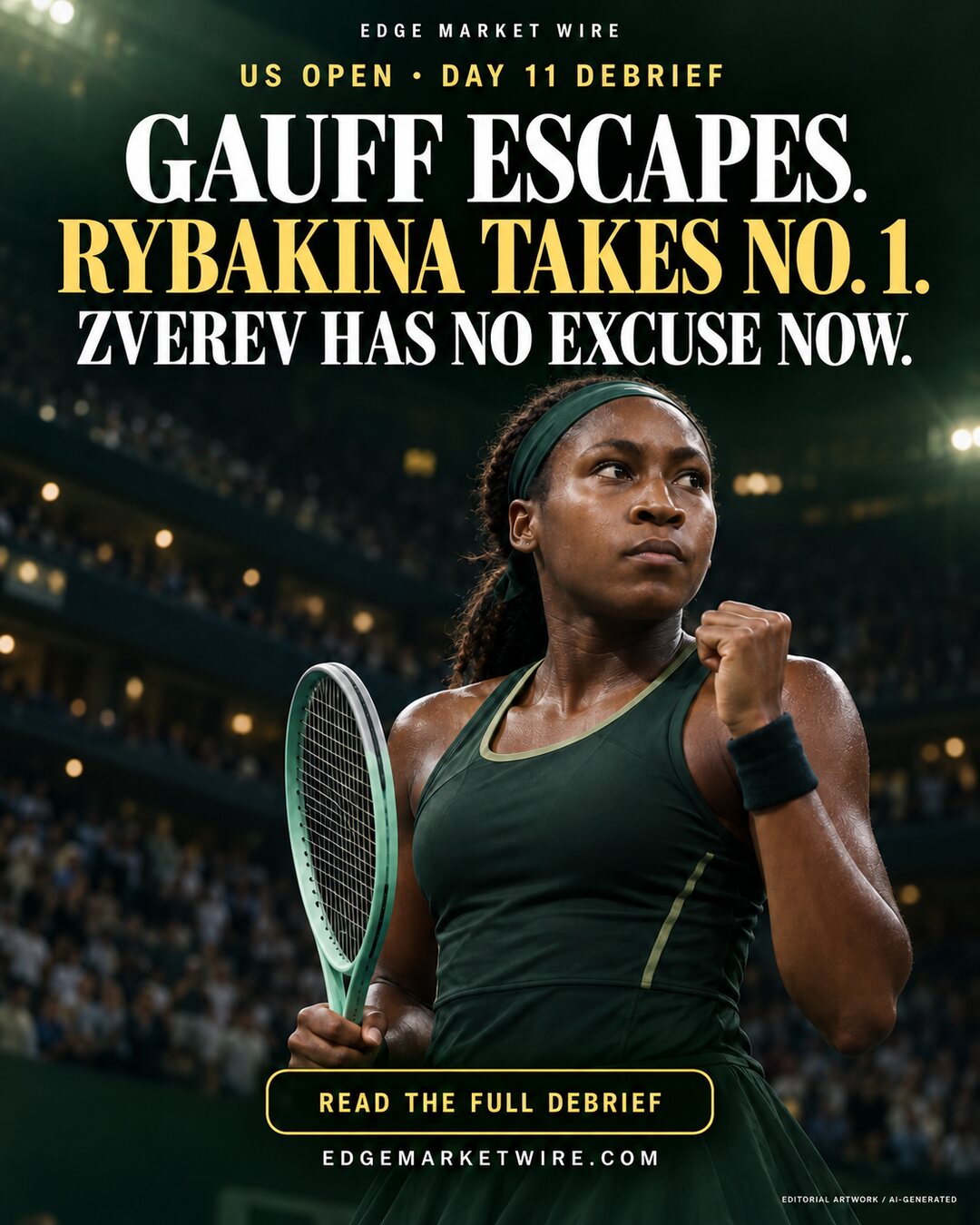
US Open Day 11 Debrief — Wednesday, September 9, 2026: Gauff escapes, Rybakina earns No. 1, and anything short of the final is an underachievement for Zverev
Coco Gauff’s comeback showed exceptional nerve but exposed problems that could end her tournament on Thursday. Elena Rybakina deservedly secured the No. 1 ranking. Alexander Blockx was right to retire. Alexander Zverev did what the top seed should do — and must now reach the final.
Day 11 is easy to romanticise.
Gauff saved two match points. Rybakina became world No. 1. Blockx played until his body would no longer allow it. Zverev advanced in straight sets.
The more useful assessment is less sentimental.
Gauff’s win strengthened her reputation as a competitor but raised serious questions about whether her tennis is good enough to win the title. Andreeva had the match in her hands and became too passive. Rybakina was the day’s most convincing title contender despite dropping the opening set. Khachanov handled an awkward match professionally, although Blockx’s physical condition limits what can be learned from it. Zverev has now reached the point where another honourable defeat would not be enough.
The Day 11 preview identified four vulnerabilities. All four became important.
Gauff’s mentality saved her. Her serve is still a major problem.
Coco Gauff def. Mirra Andreeva 2–6, 7–6(7), 6–2
Gauff’s comeback was impressive. Her overall performance was not.
Both things can be true.
She committed 42 unforced errors and 12 double faults, won only 38 per cent of her second-serve points and finished the match with a one-point advantage: 95–94.
A player can survive those numbers once. It is difficult to win a Grand Slam producing them repeatedly.
Andreeva took the opening set in 26 minutes. At 4–1, Gauff had made ten unforced errors to Andreeva’s two. Her forehand was unreliable, her serve was breaking down and she was regularly beginning points in a defensive position.
Andy Roddick’s pre-match analysis had focused on Gauff “shrinking the court” with her movement. He also identified Andreeva as one of the few players capable of matching Gauff’s variety. Served’s quarter-final analysis
That was a good reading of the matchup. The problem for Gauff was that her serve initially removed any need for Andreeva to take risks. Andreeva could remain solid and wait for the error.
The latest *Nothing Major* episode, recorded before the quarter-final, described Gauff as being “on fire” after her emphatic victory over Iva Jovic. That assessment was justified at the time. The quarter-final was a reminder that Gauff’s level can still change dramatically from one match to the next. Nothing Major’s latest US Open episode
The decisive change was not that Gauff repaired her serve. She did not. She began defending with greater depth, moved forward more often and forced Andreeva to make more difficult decisions.
Gauff won 19 of 28 points at the net. Andreeva won six of 17.
That was the most successful adjustment of the match.
Gauff still failed to serve out the second set at 5–3 and reached the tie-break without having solved the underlying technical problem. She then saved match points at 5–6 and 6–7 before winning 9–7.
Andreeva later said that, given the same opportunity again, she might “risk more”. She admitted that her intention on the match points had been to extend the rallies. Andreeva’s post-match comments
That was the wrong decision.
Playing safely against Gauff is not safe. Long rallies favour the player with the better defence, greater physical confidence and stronger support from the crowd. Andreeva had earned two opportunities to finish the match and chose not to take control of either point.
Calling it a choke is overly simplistic. Pretending she was merely unlucky would be equally inaccurate.
Andreeva became cautious when the match required commitment. Her age helps explain that response, but it should not exempt her from criticism. She is 19, but she is also the reigning French Open champion and one of the best players in the world. She should now be assessed by that standard.
Once Gauff survived the tie-break, Andreeva’s frustration became visible. Gauff broke for 2–1 in the final set, Andreeva threw her racket, and four forehand errors produced another break at 4–2.
Gauff deserves considerable credit for recognising that Andreeva was losing confidence and making her play additional balls. She did not wait for her own game to become perfect. She found a way to make her opponent’s game worse.
Her post-match discussion of “delusional” self-belief was revealing. Gauff understands that belief is the part of her performance she can retain when the technical elements disappear. Gauff’s post-match interview and official press conference
That mentality may win her another major. It does not make 12 double faults acceptable.
If Gauff serves at the same level against Rybakina, she will probably lose. Rybakina is less likely than Andreeva to become passive when the opportunity to finish appears.
Rybakina is a deserving No. 1 — and should be favoured against Gauff
Elena Rybakina def. Zheng Qinwen 3–6, 6–1, 6–4
Rybakina did not produce a perfect performance either. She did, however, solve her problems more convincingly than Gauff.
Zheng took the opening set as Rybakina struggled with the early start, the sun and the shadows across the court. Rybakina responded by winning the second set 6–1 and gradually taking control of the shorter points.
The crucial moment arrived with Zheng leading 4–3 in the deciding set.
Rybakina faced break point, moved forward and gave Zheng a reasonable look at a backhand pass. Zheng missed it. Rybakina held and broke in the next game.
That was Zheng’s opportunity. She did not receive another.
Both players won 80 per cent of their first-serve points. The significant difference was behind the second serve: Rybakina won 64 per cent, compared with Zheng’s 47 per cent.
Rybakina’s promotion to world No. 1 was not produced by one fortunate result. She won the Australian Open, added titles in Ningbo and Stuttgart and reached the finals in Indian Wells and Toronto. She has been one of the season’s most consistent players and deserves the ranking.
Tim Henman and Laura Robson said her rise had “felt inevitable”. That is a fair assessment of the season, even if this particular match was much closer than the final two sets suggest. Henman and Robson’s Sky Sports reaction
The achievement is more impressive because Rybakina retired from her Cincinnati quarter-final with an Achilles problem and went seven days without training shortly before the US Open. She had also never previously gone beyond the fourth round in New York. Match report and ranking context
Rybakina called the ranking “just a number right now”. That reflects her immediate priority, but No. 1 is not a minor administrative detail. She becomes the 30th woman to reach the position and the first representing Kazakhstan.
“It’s history, and I’m very proud representing Kazakhstan,” she said later. Rybakina’s interview and official press conference
Rybakina does not need to win the US Open to validate the ranking. The ranking measures the season, not one tournament.
Winning the title would establish something larger. It would make her not merely the new No. 1 but the clear leading player of 2026.
On the evidence of Wednesday, she should be favoured against Gauff. Her serve is more dependable, she takes the ball earlier and she is unlikely to give Gauff enough neutral rallies to recover from another poor serving performance.
Blockx was right to stop
Karen Khachanov led Alexander Blockx 6–2, 7–5, 3–2 when Blockx retired
Blockx entered the quarter-final with a rib injury, a brace on his right ankle and strapping around his thigh. During the match, he developed further pain in his back.
“Today my body just gave up,” he said. Blockx’s official press conference
He had already been close to retiring during his fourth-round victory over Francisco Cerúndolo.
Blockx was entitled to begin the quarter-final and see whether he could compete. Once his movement deteriorated, stopping was the correct decision. Continuing would not have made his tournament more admirable.
It is also reasonable to ask whether a 21-year-old carrying several injuries should have been encouraged to play for as long as he did. Grand Slam prize money, a first major quarter-final and the possibility that the pain might improve all complicate that decision. His long-term health still matters more.
Blockx leaves as the first Belgian man to reach a US Open quarter-final. That achievement should not be reduced to the way the run ended.
Khachanov handled the situation correctly. He maintained his level, avoided becoming distracted by Blockx’s condition and was already leading by two sets when the retirement came. Official match highlights and Khachanov’s on-court interview
He deserves his place in the semi-finals. The match provides limited evidence about his chances against Zverev because it stopped before Khachanov faced any sustained physical or tactical pressure.
Zverev has improved — but this victory was the minimum expected
Alexander Zverev def. Botic van de Zandschulp 6–2, 7–5, 6–1
Zverev has now won three consecutive matches in straight sets after beginning the tournament with two five-setters.
That is genuine improvement and deserves recognition.
*Nothing Major* had already noted that Zverev was beginning to find better form during the night sessions. Against Van de Zandschulp, he served effectively after an uncertain start, controlled the baseline and did not allow a competitive second set to become a longer match.
He did what the top seed should do.
Van de Zandschulp had spent five hours and 13 minutes completing a 409-point comeback against Arthur Gea in the previous round. He was not likely to become physically stronger as Wednesday’s quarter-final progressed. Zverev needed to take advantage of that, and he did.
The result should not be exaggerated into proof that Zverev is certain to win the tournament. He has spent 16 hours and 40 minutes on court, the most by any US Open men’s semi-finalist on the way to the last four since 1991, according to ESPN on X.
He has nevertheless reached all four Grand Slam semi-finals this season and recorded 23 major match wins, surpassing Boris Becker’s German men’s record of 22 from 1989.
Becker warned before Montreal that Zverev’s best opportunity would not last indefinitely. His direct assessment was that Zverev is “29, not 25” and may have another 18 months to two years at his present level. Becker’s assessment
Zverev has already answered the central question of his career by winning Roland Garros. The question now is whether he can take advantage of an unusually open US Open.
Jannik Sinner withdrew before the tournament. Novak Djokovic lost in the first round. Carlos Alcaraz was eliminated by Ben Shelton. Zverev is the only Grand Slam champion remaining in the men’s draw and faces the world No. 50 for a place in the final.
Khachanov is a serious opponent. He has beaten Felix Auger-Aliassime and Learner Tien and has previously reached major semi-finals in both New York and Melbourne.
Zverev should still beat him.
Anything short of the final would be an underachievement. Sport does not guarantee that the better player wins, but that does not mean every defeat deserves to be treated as equally acceptable.
Zverev has the ranking, experience, current form and favourable draw. He no longer needs another encouraging run. He needs to convert the opportunity.
The top of the women’s game is becoming less random
Sabalenka, Rybakina, Pegula and Gauff are the first top-four women’s seeds to reach the semi-finals of any major since Wimbledon in 2009. At the US Open, it has not happened since 1975.
That year’s semi-finalists were No. 1 Chris Evert, No. 2 Virginia Wade, No. 3 Martina Navratilova and No. 4 Evonne Goolagong Cawley. Evert went on to win the title. The WTA’s official semi-final breakdown
The statistic is more than historical trivia.
Women’s tennis has often been lazily described as inherently unpredictable. The current results suggest that description is becoming outdated. Sabalenka, Rybakina, Pegula and Gauff have separated themselves from the field through sustained results, even if the order between them remains unsettled.
That is not dominance by one player. It is the development of a credible leading group.
The Day 11 verdict
Gauff produced the best competitive escape, but not the best tennis.
Rybakina achieved the most and should enter the semi-final as the favourite.
Andreeva made the day’s clearest tactical mistake by becoming passive on her match points.
Blockx made the correct decision to retire.
Khachanov advanced professionally, although the retirement makes his performance difficult to judge.
Zverev is improving and has now won three straight-set matches in succession. He also has no convincing excuse for failing to reach the final.
Those are the conclusions from Day 11. Thursday’s semi-finals will test them.
Expected tennis start times can move when earlier matches run long or weather intervenes. Market context, not a guarantee of profit.