US Open Day 12 Preview — Thursday, September 10, 2026: Pegula confronts her Sabalenka problem, Gauff’s serve meets the worst possible opponent, and Rybakina plays as No. 1
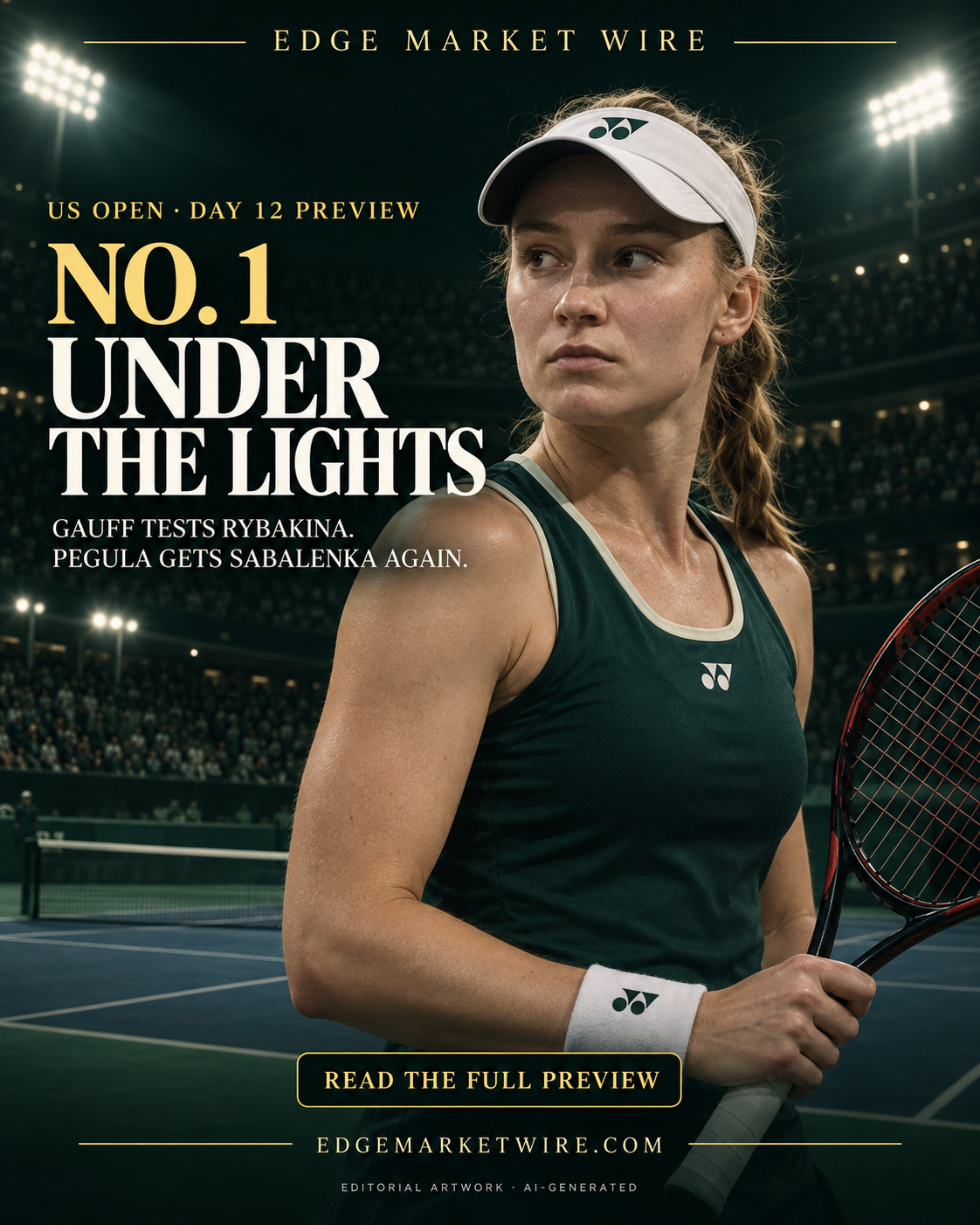
The top four seeds have restored order to the women’s draw. Thursday night will decide whether that order ends with another Sabalenka final — or the arrival of a different champion.
For the first time since 1975, all four leading women’s seeds have reached the US Open semifinals. The previous quartet included Chris Evert, Martina Navratilova, Virginia Wade and Evonne Goolagong Cawley. Evert won the title.
That is a wonderful historical footnote. It is not evidence that this tournament has been predictable.
Coco Gauff saved two match points. Aryna Sabalenka survived Linda Noskova in three sets. Elena Rybakina had to reverse a match against Zheng Qinwen. Jessica Pegula has quietly won five matches while attracting less attention than opponents who are no longer in the draw.
The latest Nothing Major episode captured the quarterfinals in suitably direct terms: Rybakina reached No. 1, Gauff survived, Sabalenka escaped and Pegula powered through. The hosts also objected to the lazy habit of reducing every Pegula discussion to her family’s wealth.
Both summaries were fair. Neither settles what happens next.
Aryna Sabalenka vs Jessica Pegula
Arthur Ashe Stadium, 7 p.m. ET
Sabalenka leads the head-to-head 9-4, has beaten Pegula in each of the past two US Opens and is trying to become the first woman since Serena Williams to win three consecutive titles in New York.
On paper, it sounds like control.
The recent history is much less comfortable for Sabalenka. Their last four meetings have all gone to a deciding set, with two wins apiece. Pegula won their most recent encounter 6-4, 6-7, 6-0 in the Berlin semifinals. Sabalenka won their last hard-court meeting at the 2025 WTA Finals, but needed three sets there as well.
The 9-4 record matters. It also exaggerates the present gap.
Pegula has won a tour-leading 50 matches this season and reached her third consecutive US Open semifinal. She has become too accomplished to be praised merely for consistency. At this point, the distinction between an excellent career and a major-winning one comes down to matches exactly like this.
Pegula said after her quarterfinal that Sabalenka has been the obstacle in New York for the past couple of years and that she has to get over it eventually. She is right. Another respectable defeat would not alter how highly she should be regarded, but it would strengthen the idea that her ceiling remains just below the very best players on the biggest nights.
The pre-tournament debate on Sky Sports now looks unusually relevant. Tim Henman was the panel’s only Sabalenka pick, arguing that major tournaments bring an “extra gear” and greater concentration from the defending champion. Laura Robson and Naomi Cavaday chose Pegula, with Cavaday pointing to her consistency and ability to be “ready to pounce” when the favourites wobble. Tennis365
Both arguments have survived the tournament. Pegula has been its most reliable player. Sabalenka has looked vulnerable without being beaten.
That distinction matters. Sabalenka’s quarterfinal against Noskova was not her best performance, but she won the decisive points and controlled the final set. Her power gives her easier ways to finish rallies, particularly when nerves tighten and both players become reluctant to take the first risk.
Pegula’s route to victory requires more than absorbing pace and waiting for Sabalenka to lose control. She must attack the second serve, redirect early and stop Sabalenka from settling into repeated forehand exchanges. Playing cleanly will keep her in the match. Taking the initiative is what can win it.
The endless focus on Pegula’s billionaire background remains poor tennis analysis. Wealth can explain access and opportunity. It cannot explain 50 wins, three successive semifinals in New York or the ability to live with Sabalenka’s weight of shot. Pegula should be evaluated for the player she has become, not treated as a novelty biography every time she reaches the final weekend of a major.
Sabalenka nevertheless deserves to start as the favourite. She owns the stronger serve, the heavier first strike and significantly more evidence that she can close this particular tournament.
Edge call: Sabalenka in three sets.
Coco Gauff vs Elena Rybakina
Follows Sabalenka–Pegula
Gauff’s quarterfinal comeback against Mirra Andreeva was a demonstration of championship mentality and an alarming piece of technical evidence.
She saved two match points, survived a 39-shot rally in the second-set tiebreak and won 2-6, 7-6, 6-2. She also produced 12 double faults, landed only 59 percent of her first serves and won 38 percent of her second-serve points. WTA
The comeback deserves admiration. The serving cannot be romanticised simply because she escaped.
Against Andreeva, Gauff could extend rallies, defend deep behind the baseline and wait for the pressure to change sides. Rybakina is a far worse opponent for an unstable second serve. She stands close, strikes flat and can turn a defensive service game into a scoreboard problem within minutes.
Andy Roddick’s observation earlier in the tournament remains the best explanation of Gauff’s underlying strength: her movement “shrinks the court.” She forces opponents to hit closer to the lines because ordinary attacking shots keep coming back. Served
That advantage is real, but it cannot repeatedly compensate for giving a returner of Rybakina’s quality free looks at second serves.
Much of the celebrity consensus before the tournament leaned towards Gauff. Marion Bartoli, Ryan Harrison and Jonathan Overend selected her in Sky Sports’ panel, while John Isner and Annabel Croft also backed her in separate predictions. Sky Sports Martina Navratilova has highlighted Gauff’s mental edge over her leading rivals, an assessment that looked persuasive when Gauff faced two match points against Andreeva and refused to disappear. Sky Sports
The experts were right about Gauff’s competitive strength. They may still have underestimated Rybakina.
Rybakina entered the tournament with an Achilles problem and seven days without training. She will leave New York as the new world No. 1 regardless of Thursday’s result. Her ranking is not a bureaucratic accident: she is 47-13 this season and has now reached her first US Open semifinal after beating Zheng 3-6, 6-1, 6-4. WTA
Henman and Robson described her rise to No. 1 as something that had “felt inevitable.” That is more convincing than Rybakina’s own insistence that the ranking is “just a number right now.” Sky Sports
It is not just a number. It confirms that she has been the best player across the full body of the season, even when the public conversation has been dominated by Sabalenka, Gauff and Iga Swiatek.
Gauff and Rybakina have split their two previous meetings. Rybakina won the latest one 5-7, 6-2, 6-2 in Toronto this summer. The matchup remains close because Gauff can make Rybakina play more balls than she wants and can expose her movement when the rallies become less linear.
But Thursday’s match starts with a blunt calculation: if Gauff serves anything like she did against Andreeva, she probably loses.
That is not dismissing Gauff’s resilience. It is recognising the opponent. Rybakina does not need many second serves in the middle of the box before she begins controlling entire games with the return.
Gauff will have the crowd, the defensive advantage and the stronger record in chaotic matches. Rybakina has the cleaner serve, the more damaging return position and the more dependable first-strike pattern. In a semifinal between two elite players, those are substantial advantages.
Edge call: Rybakina in three sets.
Thursday’s order of play
- 7 p.m. ET: Aryna Sabalenka vs Jessica Pegula
- Not before the first semifinal: Coco Gauff vs Elena Rybakina
The view from Edge
The rankings say these are the four best players in the tournament. The matches themselves pose less orderly questions.
Pegula must prove that consistency can become authority against the opponent who has repeatedly stopped her in New York. Sabalenka must show that surviving the quarterfinal restored her level rather than merely extended her title defence.
Gauff must repair the serve quickly enough for her movement and nerve to matter. Rybakina must handle the attention that finally comes with being world No. 1.
Sabalenka remains the narrow tournament favourite because she has already won this title twice and owns the most destructive tennis left in the draw. Rybakina, however, is the player whose game currently asks the fewest questions of itself.
Projected final: Aryna Sabalenka vs Elena Rybakina.
Expected tennis start times can move when earlier matches run long or weather intervenes. Market context, not a guarantee of profit.