US Open Day 10 Preview — Tuesday, September 8, 2026: Shelton promises fireworks, America gets two guarantees, and Sabalenka begins the three-peat test
Two all-American quarter-finals guarantee the home crowd a man and a woman in the last four. Ben Shelton wants to add a third — but Carlos Alcaraz has spent this tournament making American resistance look temporary.
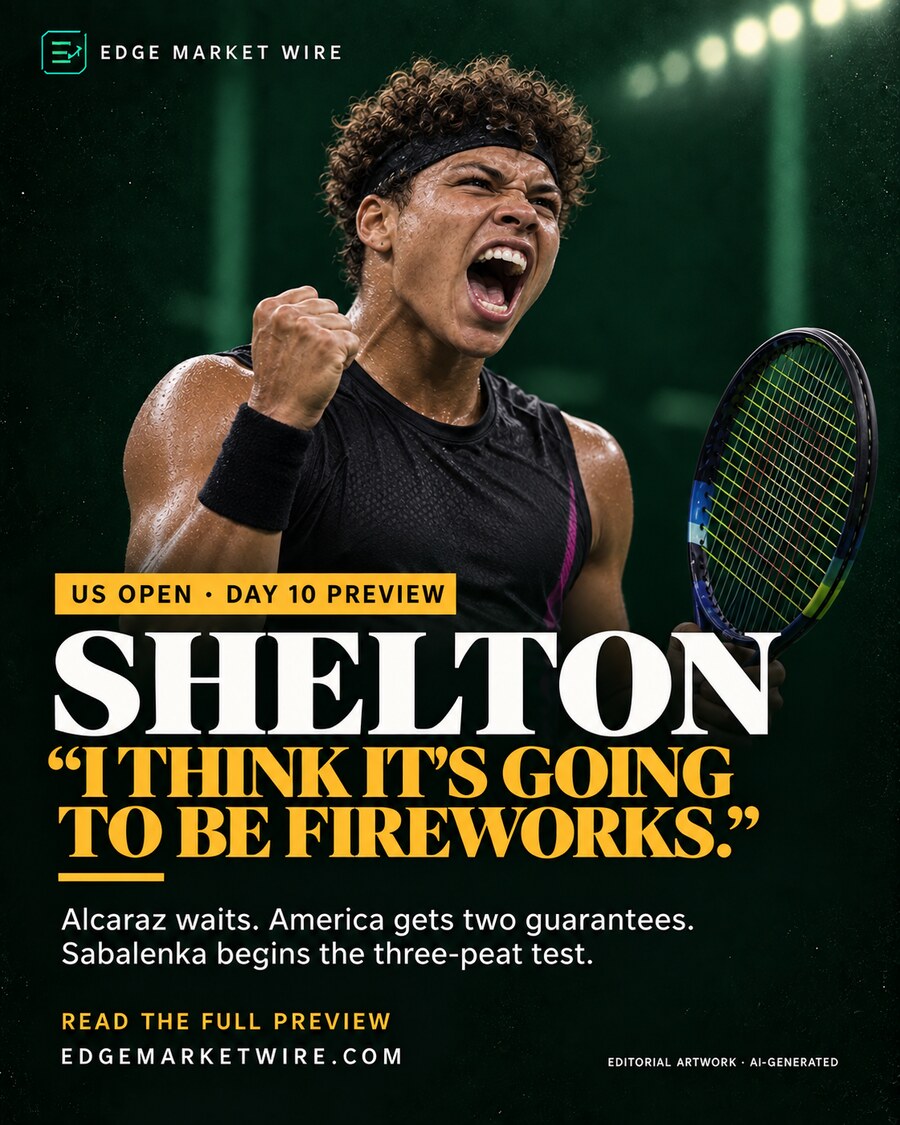
Tuesday should be loud.
Sunday left five Americans in this half of the singles draws. Tuesday converts two of them into guarantees. Frances Tiafoe and Alex Michelsen will produce an American men’s semi-finalist; Jessica Pegula and Emma Navarro will do the same for the women.
Then comes the question that turns a strong home tournament into something larger: can Ben Shelton remove Carlos Alcaraz?
The other quarter-final contains no American at all, only the world No. 1 and two-time defending champion against the woman who won Wimbledon two months ago. Aryna Sabalenka and Linda Noskova are unlikely to spend much time negotiating.
Four matches, all on Arthur Ashe. Two certainties for the home crowd, one enormous opportunity and very little neutral tennis.
Shelton needs more than fireworks
Ben Shelton was asked what it would take to beat Alcaraz.
“Fireworks,” he said.
It was a useful answer because it described both the opportunity and the danger. Shelton can create the most violent three-shot sequence left in the men’s draw. He has touched 150mph on serve, won 88 per cent of his service games during the tournament and reached the quarter-finals by giving Stefanos Tsitsipas no break point at all.
For the first time this fortnight, the chaos also arrived in the correct order. Shelton beat Tsitsipas 6–2, 6–3, 6–4 with 32 winners and 17 unforced errors. Then, instead of treating an efficient night as a reason to leave, he went to the practice court and worked up another sweat.
That detail matters. Shelton does not need to discover more force before Tuesday night. He needs to make the force repeatable.
Alcaraz has beaten him in Canada, at the Laver Cup and at Roland Garros. Shelton took a set in Paris last year, but the broader pattern has been consistent: the American can win the spectacular points while Alcaraz keeps ownership of the ordinary ones.
Shelton says the difference now is not merely his serve. He believes his return, movement and tolerance from the baseline have all improved. That is the real test. A 150mph serve can win the first ball; Alcaraz’s gift is making the next ball feel like the beginning of a different point.
Tommy Paul supplied the clearest warning after losing 6–4, 6–3, 6–4. He said the gap in their level had been “huge” and identified his backhand as the route through which Alcaraz kept reaching the forehand. Shelton’s left-handed patterns will change the geometry, but not the demand. He must protect the middle of the court, make Alcaraz return defensively and resist the urge to turn every neutral rally into an audition.
Alcaraz enters with 18 consecutive Grand Slam victories and a 13–0 record against Americans at majors. He has already beaten eight different US players in that setting. To defend the title, he may have to beat three more in succession.
He briefly forgot that part of the draw after defeating Paul, naming the wrong possible opponents before Andy Roddick corrected him live on ESPN. It was one of the few things Alcaraz misplaced all afternoon.
Served’s Day 8 notes, including Shelton’s practice session and Paul’s press-conference assessment
The ATP on Alcaraz’s draw mix-up with Andy Roddick
Olympics.com on what Shelton believes must be different this time
The market makes Alcaraz clear, not invulnerable
A morning DraftKings snapshot had Alcaraz at –421 and Shelton at +317. Remove the simple two-way margin and the prices imply roughly a 77–23 contest.
That is a large gap. It is not a forecast of a routine match.
Shelton’s serve compresses the number of meaningful points and the Ashe crowd can make a single return game feel like a change in weather. The difficulty is that Alcaraz is unusually good at surviving the noisy version of a match until the better tennis reappears.
For Edge Market Wire, the distinction is important: a market price is not a signal by itself. A signal requires a measurable discrepancy between the available price and a credible reference or fair price. The headline matchup does not receive an invented edge merely because it is interesting.
Current Shelton–Alcaraz market snapshot via DraftKings
Tiafoe leaves the people’s court
Frances Tiafoe is 10–0 on Louis Armstrong Stadium and has started calling it “the people’s court”. His reward for finally beating Daniil Medvedev is to leave it.
Arthur Ashe offers more seats, more noise and slightly less intimacy. It also offers Tiafoe a familiar route back to the semi-finals. He has reached that stage here twice and has won both of his previous professional meetings with Michelsen in straight sets.
The recent evidence belongs to the younger American. Michelsen has not lost a set in four matches and reached his first major quarter-final without turning any of them into an endurance contest. His lead-in form was poor enough that even he admitted the run had surprised him. The underlying belief had not disappeared.
“I always had a feeling it would come,” he said.
This is where clean progress meets New York experience. Michelsen’s backhand and early court position can prevent Tiafoe from decorating the match. Tiafoe’s variation, movement forward and ability to borrow energy from a stadium can make Michelsen solve several versions of the same opponent.
Tiafoe described Michelsen as “a hell of a player”. Michelsen called the prospect of playing his friend on Ashe “an absolute blast”. Both statements can be true for approximately five minutes. After that, one of them becomes the man standing between the other and a US Open semi-final.
The market has treated Tiafoe as only a modest favourite, around 57–58 per cent in available snapshots. That feels appropriate. He owns the history and the higher proven New York ceiling; Michelsen owns the cleaner fortnight.
The US Open’s official Tiafoe–Michelsen quarter-final preview and player reaction
Current tournament market probabilities
Pegula and Navarro remove the nationality question
The night session begins with a guarantee. Either Jessica Pegula or Emma Navarro will reach the semi-finals.
Pegula has won all four of their previous meetings, most recently 7–5, 6–2 in Cincinnati last month. She also arrives with 49 victories this season, the highest total on the WTA Tour, and the knowledge that three more wins would take her to the world No. 1 ranking.
None of that makes the match automatic.
Navarro’s season was interrupted by an extended health absence. Her return to the last eight is therefore more than another example of a compact game surviving a draw. She has again found the balance that makes opponents feel as though they are attacking without gaining territory: early contact, disciplined depth and very few empty service games.
Pegula’s advantage is that she plays that language even faster. She takes the ball early, protects the centre and can turn a neutral exchange into an attacking one without changing the visible speed of her swing. Navarro needs height, variation and enough disruption to prevent Pegula from establishing the same contact point for an entire set.
This will not have Shelton’s volume. It may be the day’s purest examination of court position.
Pegula is the rightful favourite because the head-to-head is no accident. Navarro’s opportunity is to make the fifth meeting less orderly than the first four.
The US Open on Pegula and Navarro’s all-American quarter-final
Sabalenka begins the three-peat test against a Wimbledon champion
Aryna Sabalenka has not lost a set in New York. Linda Noskova has not lost a Grand Slam match since June.
That is the correct scale of the opening quarter-final.
Sabalenka is chasing a third consecutive US Open title, something no woman has achieved since Serena Williams from 2012 to 2014. Noskova arrives as the reigning Wimbledon champion and the youngest Czech woman to reach the last eight here since Daja Bedanova in 2001.
The head-to-head favours Sabalenka, who has won both meetings in straight sets. The conditions also appear designed for her: a sunny afternoon rising toward 29C, a lively hard court and an opponent who prefers taking the ball early rather than forcing the world No. 1 to manufacture her own pace.
But Noskova’s route is visible. Sabalenka’s 6–4, 6–3 win over Taylor Townsend contained 11 breaks of serve. The champion controlled the ending, not every service game before it. Noskova must attack the second serve without confusing aggression with impatience.
Her own fourth round was emotionally expensive. Marta Kostyuk saved five match points before Noskova finally converted the sixth and completed a 7–5, 5–7, 6–4 victory. Noskova described the finish as a huge rock falling from her heart.
There will be very little time to feel lighter. Sabalenka’s first return game will ask whether the recovery was emotional, physical or both.
Noskova has called the matchup “fast tennis”. It may be the most economical piece of analysis produced all week. Both women want the same territory, the same early contact and the same short reply. The winner will be the player who can attack first without becoming the first to rush.
Official US Open Day 10 preview
Official US Open report on Noskova’s fourth-round win
The former-player layer
The latest *Nothing Major* episode — with Sam Querrey, John Isner and Steve Johnson — devotes its closing stretch to today’s quarter-finals: Shelton–Alcaraz from 23:36, Tiafoe–Michelsen from 26:02 and the women’s picks from 29:57.
Andy Roddick’s latest *Served* episode also closes with a quarter-final preview after reviewing Monday’s matches. The useful point is not to borrow an unverified prediction. It is to add the questions former players consider worth examining: whether Shelton’s cleaner baseline level can survive Alcaraz, whether Michelsen’s set-perfect run travels onto Ashe, and whether either American women’s pattern can make the familiar opponent uncomfortable.
Nothing Major: Shelton set for Alcaraz clash and quarter-final preview
Served with Andy Roddick: Day 9 recap and quarter-final preview
Tuesday’s order of play
**17:30 CEST / 11:30 a.m. ET** — Aryna Sabalenka vs Linda Noskova, Arthur Ashe Stadium.
**Not before 19:00 CEST / 1:00 p.m. ET** — Frances Tiafoe vs Alex Michelsen, Arthur Ashe Stadium.
**01:00 CEST Wednesday / 7:00 p.m. ET** — Jessica Pegula vs Emma Navarro, Arthur Ashe Stadium.
**Following Pegula–Navarro** — Carlos Alcaraz vs Ben Shelton, Arthur Ashe Stadium. Around 02:30 CEST is a guide, not a fixed start.
Every match is available in Sweden through HBO Max, with broad television coverage across Eurosport. The afternoon is forecast to be sunny and warm, reaching roughly 29C; the night session should remain clear and warm.
HBO Max’s Swedish US Open coverage
The closing read
Sabalenka is the likelier winner in the opener, but Noskova is the first opponent here with both a current major title and the pace to deny her rhythm.
Tiafoe has the New York history; Michelsen has the cleaner tournament. Pegula owns the head-to-head; Navarro has already done the harder personal work required to make the match possible.
Alcaraz is the strongest favourite of the day. Shelton is the reason to stay awake.
America is guaranteed two semi-finalists before the night is over. The final match decides whether the home tournament is merely healthy or suddenly dangerous.
Tuesday should be loud. Shelton’s job is to make the noise last longer than the fireworks.
*Market prices are snapshots and can move. Any quoted odds are context, not betting advice or an Edge Market Wire signal unless explicitly identified as one.*
Expected tennis start times can move when earlier matches run long or weather intervenes. Market context, not a guarantee of profit.