US Open Day 12 Debrief — Thursday, September 10, 2026: Sabalenka overpowers Pegula, Rybakina attacks Gauff’s forehand, and No. 1 faces her replacement
Edge picked the correct finalists. The routes told us more: Aryna Sabalenka needed only 80 minutes to remove Jessica Pegula, while Elena Rybakina recovered from a dreadful opening set by directing the match towards the weakness Coco Gauff still cannot reliably protect.
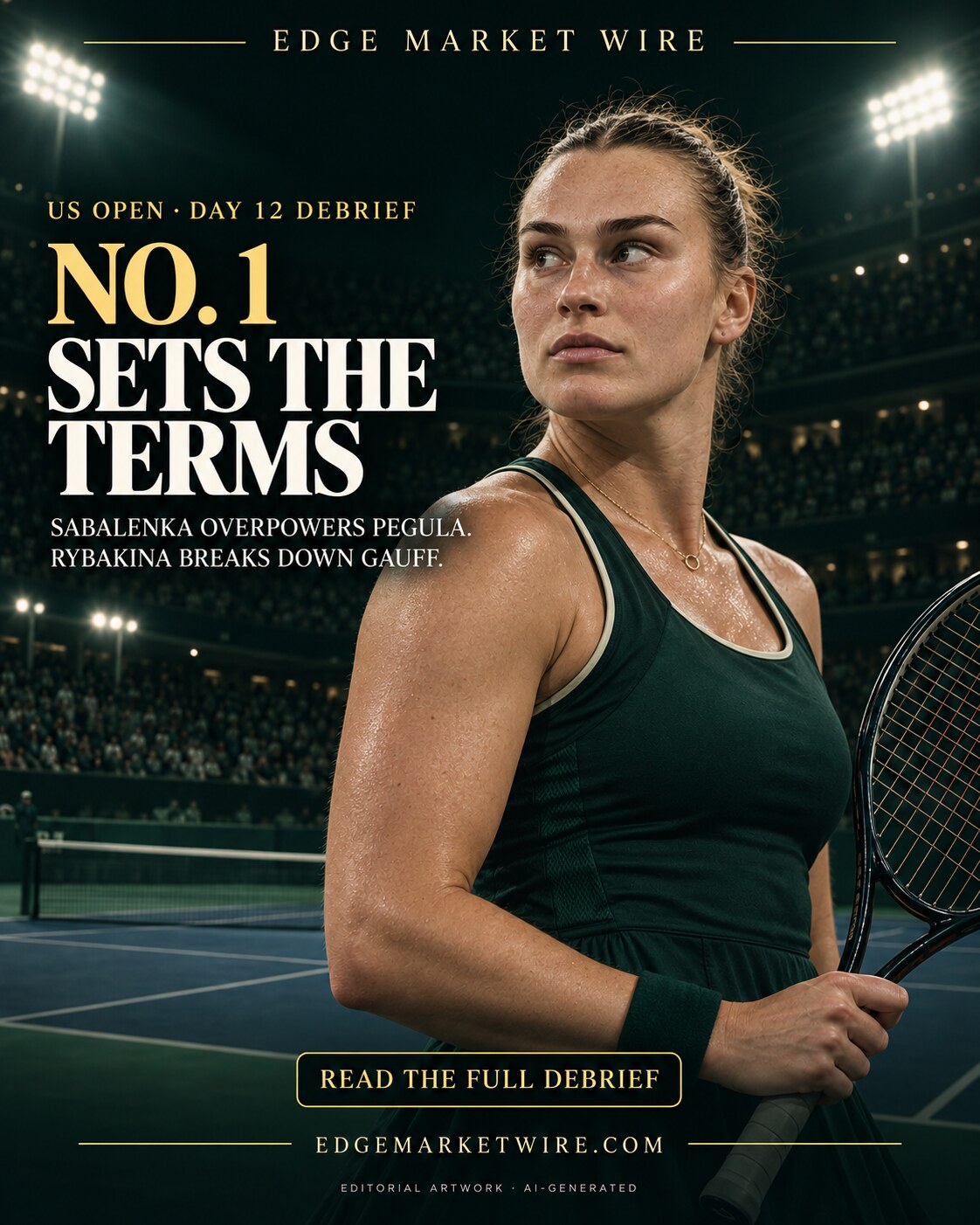
Edge picked the correct finalists. That does not make Thursday predictable in retrospect. It makes the way the two finalists arrived more revealing.
Aryna Sabalenka beat Jessica Pegula 7-5, 6-2 in 80 minutes. Elena Rybakina recovered from an erratic opening set to beat Coco Gauff 3-6, 6-4, 6-4. The scores gave us the final the seeding promised. The matches exposed why the gap between the top four is not as tidy as the numbers suggest.
Pegula played well enough to stay level with Sabalenka for most of a set. Gauff played brilliantly enough to make Rybakina look lost for one. Neither was sufficient.
That is the sharp truth of the evening: competing with elite power is not the same as controlling it.
Sabalenka did not solve the Pegula problem. She removed the question
The opening set was close until it suddenly was not.
Pegula matched Sabalenka through ten games. The average rally remained short, both players protected court position and the American found the only break point Sabalenka faced all night. Sabalenka erased it with a forehand winner, added a forehand volley and held for 5-4.
At 5-6, the match turned without a long warning. Sabalenka won an eight-shot exchange with a backhand, drew another error after a second eight-shot rally and attacked Pegula’s second serve with a forehand winner to reach 0-40. Pegula saved one set point. She could not save the next.
The first set had been even for roughly 40 minutes. Sabalenka took it 7-5 because equality ended the moment she raised the speed.
The second set was the consequence. Pegula won only five of 19 points behind her second serve, Sabalenka broke for 3-1 and the resistance became increasingly theoretical. Sabalenka finished with 29 winners to Pegula’s 12, seven aces and no service breaks conceded.
This was not Pegula choking. It was a matchup reaching its ceiling.
Pegula’s timing, return and ability to redirect pace make her one of the best hard-court players in the world. Against Sabalenka in New York, however, too many neutral balls arrive already carrying a demand. Pegula can absorb them for a while. If Sabalenka keeps landing, absorption is not a winning plan.
Pegula’s own verdict was cleaner than any sympathetic rewrite: “She played insane.”
She did. Pegula did not play badly and lose. She played reasonably well and discovered that Sabalenka had another level available. There is a difference, and serious analysis should not blur it to protect the defeated player.
For the third consecutive US Open, Sabalenka has ended Pegula’s tournament. The 2024 final was 7-5, 7-5. Last year Pegula took the opening set before losing in three. This time the contest lasted one competitive set and one demonstration.
The so-called Sabalenka problem is therefore not psychological theatre. It is a technical and physical problem. Pegula needs greater protection on the second serve, needs to redirect the first heavy ball closer to the lines and probably still needs Sabalenka’s level to fall. The first two are difficult. The third is not a strategy.
The Guardian’s match report on Sabalenka’s 7-5, 6-2 victory
No. 1 is leaving the ranking, not the stage
Sabalenka has now won 19 consecutive matches at the US Open and reached four straight finals here. She is one victory from becoming the third woman in the Open era to win three consecutive US Open titles, after Chris Evert and Serena Williams.
That is the correct historical company. It is also why the ranking story should not be allowed to swallow the tennis.
Rybakina will replace Sabalenka as world No. 1 on Monday regardless of Saturday’s result. When Sabalenka was asked how it would feel to win the tournament while losing the ranking, her first answer was: “I don’t care.”
Good.
Rankings measure a season. Finals settle a tournament. Sabalenka cannot change Monday’s calculation, but she can make the succession feel incomplete by keeping the trophy Rybakina came to take.
Thursday was the strongest argument Sabalenka has made all fortnight. She arrived after a difficult quarter-final against Linda Noskova and played with more discipline, not more decoration. Against Pegula, the correct decision kept presenting itself and she kept taking it.
The power is obvious. The more important development is that Sabalenka no longer needs anger to keep it alive. She can look furious, sound furious and still choose the right ball.
Rybakina found Gauff’s forehand and refused to look away
For one set, Coco Gauff made the matchup analysis look foolish.
She served with speed, defended the baseline superbly and forced Rybakina into 18 unforced errors. Rybakina’s first serve — the shot meant to give her ownership of short points — was unreliable. Gauff took the opening set 6-3 and looked like the player with the cleaner answer to every question.
Then Rybakina changed the examination.
She began creating more width with the backhand, moved forward inside the baseline and directed an increasing share of the traffic towards Gauff’s forehand. Early in the deciding set, 52 per cent of Rybakina’s shots were already going to that wing.
That was not subtle. It did not need to be.
Rybakina moved 4-1 ahead in the second set. Gauff fought back to 4-4, but the forehand had begun to lose its shape under pace. Serving at 4-5, she produced three forehand errors and a double fault. Rybakina had the set.
The decisive set followed the same argument. Rybakina’s serve finally arrived, including two heavy aces in a hold for 2-1. Gauff stayed close through defence, backhand quality and nerve, but the forehand remained the side Rybakina trusted least.
At 3-4, Gauff was broken. She produced the sort of resistance that has become her signature and broke back for 4-5 with a superb backhand pass. It was brave, athletic and too late to change the diagnosis. Rybakina stepped inside the court again in the next game, attacked the return and completed the match when Gauff sent an overhead long.
The serve was not the reason Gauff lost. That matters after a tournament in which every double fault has been treated as breaking news. Her serving has improved. The forehand is now the larger obstacle, precisely because elite opponents do not have to guess where the instability lives.
Gauff can defend it for stretches. She can run around it when the pattern allows. Against a hitter as clean and unsentimental as Rybakina, those are temporary arrangements.
This is not a verdict on a 22-year-old player’s future. It is a verdict on Thursday night. Gauff’s fight kept the match alive; her forehand prevented her from owning it. Praising the fight while ignoring the wing would be empty politeness.
Rybakina deserves equal credit for making the problem permanent. She did not play well in the first set and did not pretend otherwise. Her reset was simple — “I took a deep breath” — but the tennis after it was concrete: greater width, more first-strike intent and relentless pressure into the weaker side.
The Guardian on Rybakina’s three-set recovery against Gauff
The Guardian’s live match account and point-by-point tactical detail
What the famous voices got right — and what the matches corrected
The useful thing about former-player coverage is not celebrity. It is whether the analysis survives contact with the score.
The latest *Nothing Major* episode reached the women’s semifinal picks at 39:59 after Sam Querrey, John Isner and Steve Johnson had recapped the four quarter-finalists. Their larger framing was right: Pegula’s consistency deserved more respect than the lazy billionaire narrative, Gauff had survived rather than solved every issue, Sabalenka had escaped a genuine scare and Rybakina’s new No. 1 status did not finish her tournament.
Thursday sharpened that picture. Pegula’s consistency brought her to 5-5 and no farther. Gauff’s survival skills bought her a late break and no second escape. Sabalenka’s quarter-final vulnerability vanished once her first strike found Pegula’s second serve. Rybakina treated the ranking as a milestone and the semifinal as unfinished work.
One reference is enough because the matches supplied the verdict.
Nothing Major’s quarter-final recap and women’s semifinal picks
The better quotations came from the players. Pegula did not manufacture a consolation story. Sabalenka did not pretend the No. 1 calculation mattered more than the final. Rybakina did not describe a mystical transformation; she described breathing, thinking positively and changing the match.
That is more useful than a wall of famous names. Analysis should explain the tennis, not use celebrity as confetti.
The final the season deserves
Sabalenka against Rybakina is not merely the old No. 1 against the new one. It is the rivalry that has defined the top of the women’s tour in 2026.
Rybakina won the Australian Open final in three sets. Sabalenka answered by saving a championship point and winning the Indian Wells final in a deciding tiebreak, then beat Rybakina again in the Miami semifinals.
Sabalenka therefore leads this season’s series 2-1. Rybakina owns the major final between them.
That is a better setup than a ranking-decider would have been. The calculation is already complete, so neither player can hide behind it. Rybakina will be No. 1 on Monday. Sabalenka is still the champion of New York until somebody beats her.
The tactical shape is severe. Both women want the first strike. Both can remove a service game from the scoreboard before the returner has settled. Rybakina’s serve is the cleaner source of control when it lands; Sabalenka is the more complete aggressor once a rally reaches its third and fourth ball.
Sabalenka should be the favourite. Nineteen consecutive wins in New York are not atmosphere; they are evidence. Her return pressure against Pegula was better than anything Rybakina produced in the opening set against Gauff, and her tolerance for one extra ball has improved.
But a comfortable Sabalenka prediction would be lazy. Rybakina beat her in Melbourne, held championship point at Indian Wells and has now won two difficult three-set matches in succession without playing her best tennis. The new No. 1 has become harder to remove on an imperfect day.
Edge picked both finalists. For Saturday, the early lean is Sabalenka — narrowly, and because New York remains the one place where her power comes with institutional memory.
Rybakina owns Monday’s ranking.
Sabalenka still owns Saturday’s terms.
Day 12 in numbers
- Sabalenka def. Pegula: 7-5, 6-2
- Rybakina def. Gauff: 3-6, 6-4, 6-4
- Sabalenka: 29 winners, seven aces, zero breaks of serve conceded
- Pegula: five points won from 19 behind the second serve
- Sabalenka in New York: 19 consecutive victories and a fourth straight final
- Saturday’s final: outgoing No. 1 Aryna Sabalenka vs incoming No. 1 Elena Rybakina
The top four seeds restored order to the semifinal draw. Sabalenka and Rybakina then reminded everybody that order at the top does not mean equality.
One finalist overwhelmed the player who knows her best.
The other found the shot her opponent still cannot trust.
Now the ranking changes hands — and the trophy may not.
Expected tennis start times can move when earlier matches run long or weather intervenes. Market context, not a guarantee of profit.